
Inside Decatur Property Tax Records
Two offices split the work. The Board of Tax Assessors sets fair market value and the 40-percent assessed value that follows from it. The Tax Commissioner then applies adopted millage, issues the bill, posts payments, and pursues delinquent accounts. Always check the source label before trusting any figure.
| Field | What It Shows | Where |
|---|---|---|
| Fair market value | Assessor estimate of full value | QPublic parcel card |
| Assessed value | Georgia's 40-percent taxable basis before exemptions | Assessor roll |
| Exemptions | Homestead or other approved tax relief | Assessor record |
| Bill and status | Charges, payment, balance, or delinquency | Tax Commissioner |
| District and millage | Taxing jurisdiction and rates applied | Roll and bill |
Market value is not the last sale price. Assessed value is not the amount owed. The final bill blends the assessed basis, any exemptions, and millage across the applicable districts, so each figure answers its own question. Verify every tax year separately.
QPublic Holds Decatur Assessment Data
The Decatur QPublic search connects address, owner, and parcel-number queries to the certified roll. Published fields may include location, legal description, class, tax district, millage, acres, exemption codes, land lot and district, plus values for land, improvements, and accessories. Field labels can change between roll years. Treat the parcel number as the bridge between the assessment record and the tax account, and save the roll year along with any "last data upload" notice. View the official assessor source shown below.
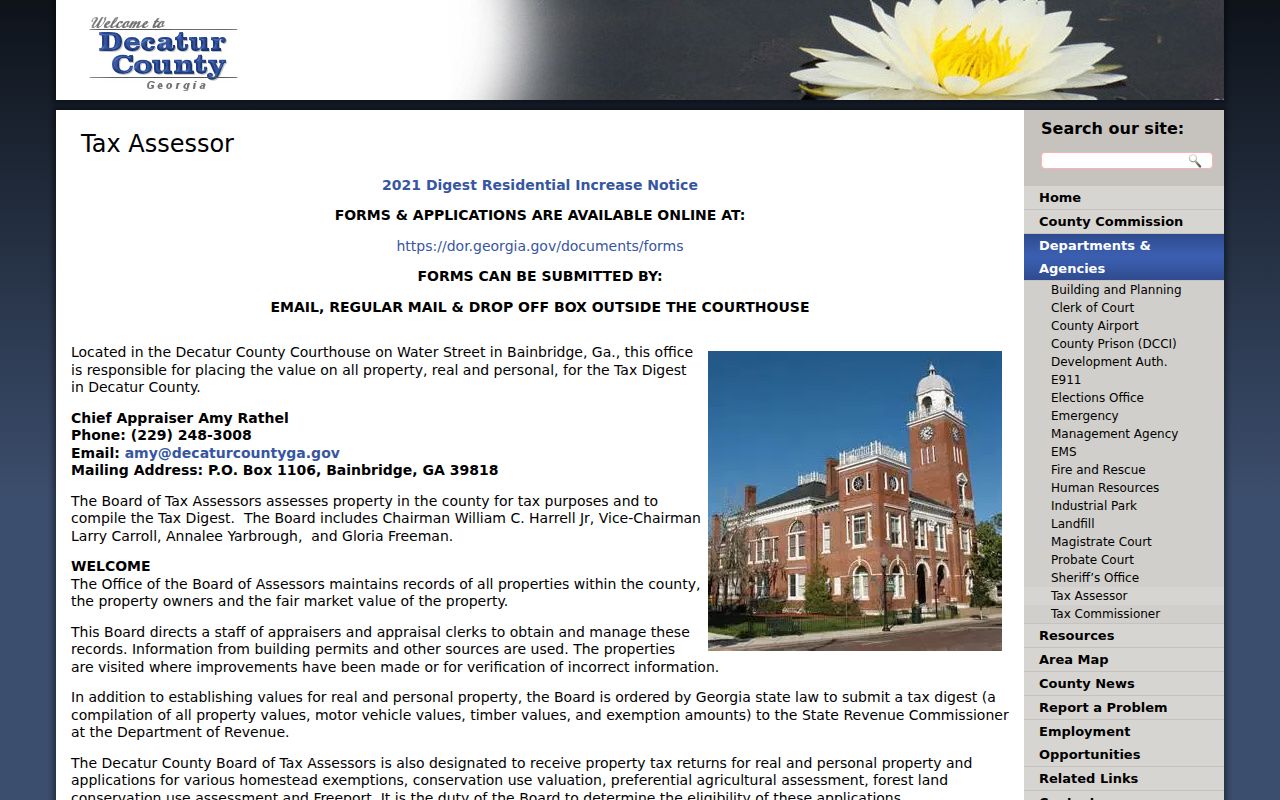
The assessor page identifies valuation and appeal duties, while QPublic supplies the parcel-level record.
Look Up a Decatur Tax Bill
The Tax Commissioner's property page covers the county bill, due dates, exemptions, tax executions, and the collection process. Public search filters and displayed fields on its Search and Pay entry are not published in detail, so results may vary. Before starting, gather the address, the owner's exact spelling, and the parcel number.
- Identify the correct parcel in QPublic and copy its ID and tax year.
- Open the Tax Commissioner search or contact the office for the current and prior bill.
- Compare assessed value, exemptions, district, millage, amount billed, and payment status.
- Ask about delinquency, FiFa, levy, tax sale, redemption, and any release when applicable.
- Assessed value
- The statutory portion of fair market value used before exemptions.
- Millage
- The rate applied to the taxable assessment.
- Homestead exemption
- Approved relief tied to a qualifying primary residence.
- Tax lien or FiFa
- A recorded tax execution used in delinquent collection.
Decatur's January First Tax Rule
Georgia property tax hinges on January 1. Decatur's Tax Commissioner holds the prior January 1 owner generally liable for that year's tax. That liability applies unless a closing statement arrives within 90 days of the due date. A recent buyer, the certified-roll owner, and the bill recipient can therefore be three different people. Name your source precisely when describing who owes what. "Owner on the certified roll" is not "grantee in the newest recorded deed." Check the Clerk's deed index before assigning a tax account to a current owner. Never treat a mailing address as proof of ownership.
Note: Real-property tax is generally due December 20. Mobile-home tax is due April 1; verify the current bill for exceptions.
Decatur Exemptions and Returns
The county assessor accepts property returns and exemption filings between January 1 and April 1. QPublic may display a homestead status or code. Yet the code alone says nothing about eligibility or whether a new application won approval. Start with the assessor's official landing page for current forms and exemption details. Ask the office directly which proof supports the claimed exemption. Keep the filed form, receipt, and decision together in your records. A deed transfer, trust, estate event, or change in use can all trigger a fresh review of the exemption. That review may reset the exemption entirely.
FiFas in Decatur Tax Research
An unpaid account can produce a FiFa. The Tax Commissioner records it with the Clerk after more than 30 days. That filing proves collection activity, not an open debt. Search onward for a payment, cancellation, release, levy, tax deed, redemption, or court case. Georgia tax-sale title rests on a statutory redemption framework. Never read a tax deed like an ordinary market deed. Examine the redemption steps, notices, and any quiet-title proceeding before calling the title clear.
Decatur Tax Sale Information Gaps
The official Decatur County tax-sales page lays out the office route, though its body publishes no current sale list. Old advertisements may be canceled, paid, postponed, or superseded. Confirm any sale directly with the Tax Commissioner. See the official tax-sale source captured below.
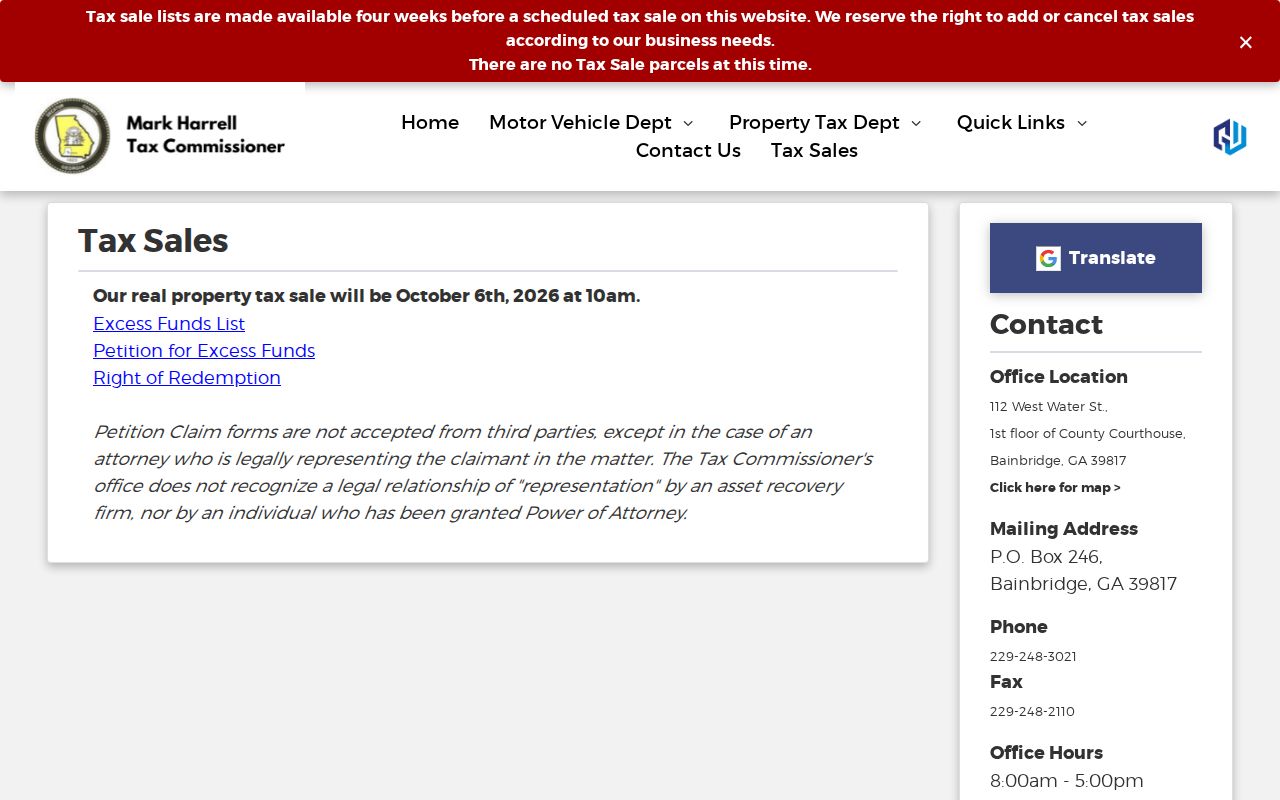
The image identifies the county source. It is no substitute for a dated sale notice and parcel verification.
Decatur Values Need Deed Context
A QPublic value is an assessment figure. A deed's stated consideration, or its PT-61 record, concerns a transfer. A tax bill is a levy. Each answers a separate question, often dated differently, so disagreement between them signals no error. Use Georgia DOR valuation guidance for the 40-percent framework. Use the PT-61 index for transfer-tax context. Remember that a nominal deed amount, family transfer, partial interest, or multi-parcel deal may skew a price. Such a transfer may not reflect an arm's-length parcel price.
Open Records for Missing Tax Files
When an older card, notice, return, appeal file, or account detail is missing online, send a narrow request to the office that holds it. Georgia's Open Records Act generally requires a response within three business days. Otherwise, the office sends a written timetable with a cost estimate and cited exemption. Identify the parcel, tax year, desired document, and electronic format. The assessor keeps valuation and appeal materials. The Tax Commissioner keeps billing and collection records. The Clerk holds recorded tax executions and related instruments.
Appeal a Decatur County Assessment
Appeals in Decatur County run on a strict clock. The Board of Tax Assessors gives owners 45 days from the assessment-notice date to file. Before filing, check the parcel facts. Comparable sales, a recent arm's-length transfer, photos, a survey, or repair evidence can all support the case. Corrections to acreage, class, improvements, or exemptions help too.
Follow the county's current filing procedure and keep proof of delivery. The appeal should name the value or classification disputed and the grounds selected. A tax bill does not restart the appeal clock. Valuation questions go to the assessor. Payment questions go to the Tax Commissioner.
Appeal window. File with the Decatur County Board of Tax Assessors within 45 days of the assessment-notice date and keep dated proof of submission.
Decatur Property Tax Calculation Checks
Rebuilding a bill works best in stages. Begin with fair market value. Apply the 40-percent assessment ratio. Subtract any qualifying exemption from the proper base. Then multiply by the millage for each district listed. One mill equals one dollar per thousand dollars of taxable assessment. Separate taxing authorities and exemption rules can change the account. The actual bill still controls.
Compare like years when checking numbers. A current QPublic card may show a value history. The payment portal may open a different bill year. Keep the notice, assessment card, bill, and receipt together in one file. If the math differs, ask the assessor about valuation or exemption data. Ask the Tax Commissioner about millage, credits, and posting.
Never treat a sale price as assessed value. A single sale may bundle multiple parcels, a partial interest, family consideration, or personal property. The PT-61 index and deed can clarify what transferred. The assessor can say whether the sale counted as a fair-market comparison.
Tax Record Changes After Closing
Closing on a property does not flip every public screen at once. The Clerk may index the deed. The certified roll can still show the old owner of record. Tax accounts can stay with the January 1 owner. Closing documents must arrive under the Tax Commissioner's stated rule for that to change. Prorations on a private closing statement never rewrite the county's public bill.
Buyers and sellers should line up four dates. These are the recorded deed date, the assessment-roll year, the bill year, and the receipt. The prior-owner rule sometimes applies. Submit any requested closing statement within the county's 90-day window after the due date. Ask the office how to identify a payment. That way it posts to the right parcel and year.
No Decatur source publishes a fixed deed-to-roll refresh interval. So avoid promising a new owner name within a set number of days. The honest answer names the source and date. That may be the latest deed, the current certified-roll owner, or the current bill recipient.
Tax records also call for a jurisdiction check. A Bainbridge, Attapulgus, or Brinson mailing label alone proves nothing. It does not establish city limits or a city tax district. Compare the district field, the incorporated boundary, and any recorded annexation material. Rural ZIP areas can straddle the line between a municipality and unincorporated Decatur County. If a district code looks wrong, bring the assessor the parcel number and legal description. Include map context and the notice or bill in question. Planning records may explain the annexation. But the tax offices must confirm how it appears on the digest and bill. Keep the written response with the tax-year file.
Confirm whether separate city, school, or special-district millage applies. Never infer the district from a postal city name or a nearby landmark. The parcel's tax-district field is better evidence for that tax year. The actual bill is too.