
Decatur County Deed Types
The Clerk of Superior Court keeps Decatur County deed records. Each instrument does different work. A deed conveys an interest in land. A security deed backs a debt, a lien stakes a claim, and a release can end an earlier filing, so read related instruments together rather than one at a time.
| Deed Type | What It Does | Common Use |
|---|---|---|
| Warranty deed | Conveys an interest with stated warranties | Market transfer |
| Quitclaim deed | Conveys whatever interest the grantor holds | Family transfer or cleanup |
| Executor deed | Conveyance by an estate fiduciary | Estate sale |
| Tax deed | Instrument following a tax sale | Tax enforcement |
| Security deed | Secures repayment with real property | Financing |
The deed type points to your next step. A quitclaim demands a close look at the grantor's own earlier interest, since it passes only what that grantor held. A tax deed raises redemption and later-title questions. An estate deed should be checked against probate authority. None of them proves who currently occupies the parcel or pays the tax bill.
QuickLink Opens Decatur's 1823 Index
The Decatur historic QuickLink opens General Grantor and Grantee Index books covering 1823 through 1994. Its General Index to Plats reaches from 1853 to 2004. Fields you can browse include index-book type, year, last name, and first name.
Search initials and spelling variants, and save every reference you find. Then pull the matching deed image through GSCCCA or the Clerk. Watch for estates, trustees, and companies. Also note "et al." entries that can break a simple name chain.
Open the historic deed-index source shown below.
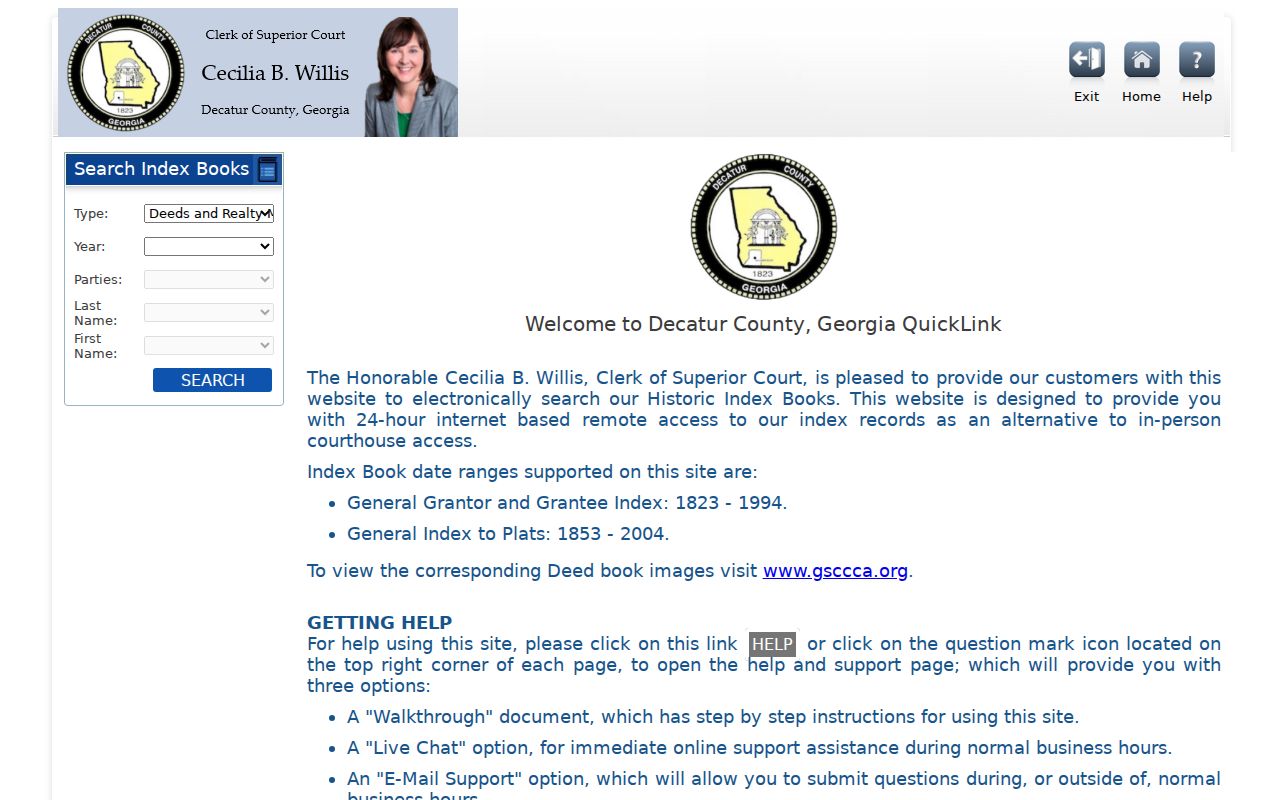
The index only charts the route. The deed image holds the operative terms.
Walk Decatur's Grantor-Grantee Chain
A grantor conveys the interest; a grantee receives it. Start from the most recent deed you can identify, because that document's grantor is usually the name to hunt for as grantee in the next older deed. Repeat the process back through the years, matching land descriptions at every step so the chain stays on the same tract.
- Find the current owner's acquisition deed under the grantee name.
- Copy the grantor, date, deed type, book/page or instrument, and full description.
- Search that grantor as a grantee and confirm the same tract.
- Repeat; use probate, plats, and court files when the chain breaks.
- Grantor
- The party transferring the stated interest.
- Grantee
- The party receiving that interest.
- Chain of title
- The linked sequence of transfers for the same land.
- Book/page or instrument
- The recorded location or unique filing identifier.
Modern Decatur Deed Search
The GSCCCA Real Estate Index holds statewide deed data from January 1, 1999 onward. You can search by name, county, book and page, or property. Subdivision and lot, instrument type, address, map, and daily transactions are covered too. Some images and advanced functions require an account or payment.
Statewide coverage overlaps the local historic system, so check both routes for 1999 through 2004. The Clerk's real-estate division stays the custodian of record. It offers a counter or terminal fallback.
See the statewide deed-index source below.
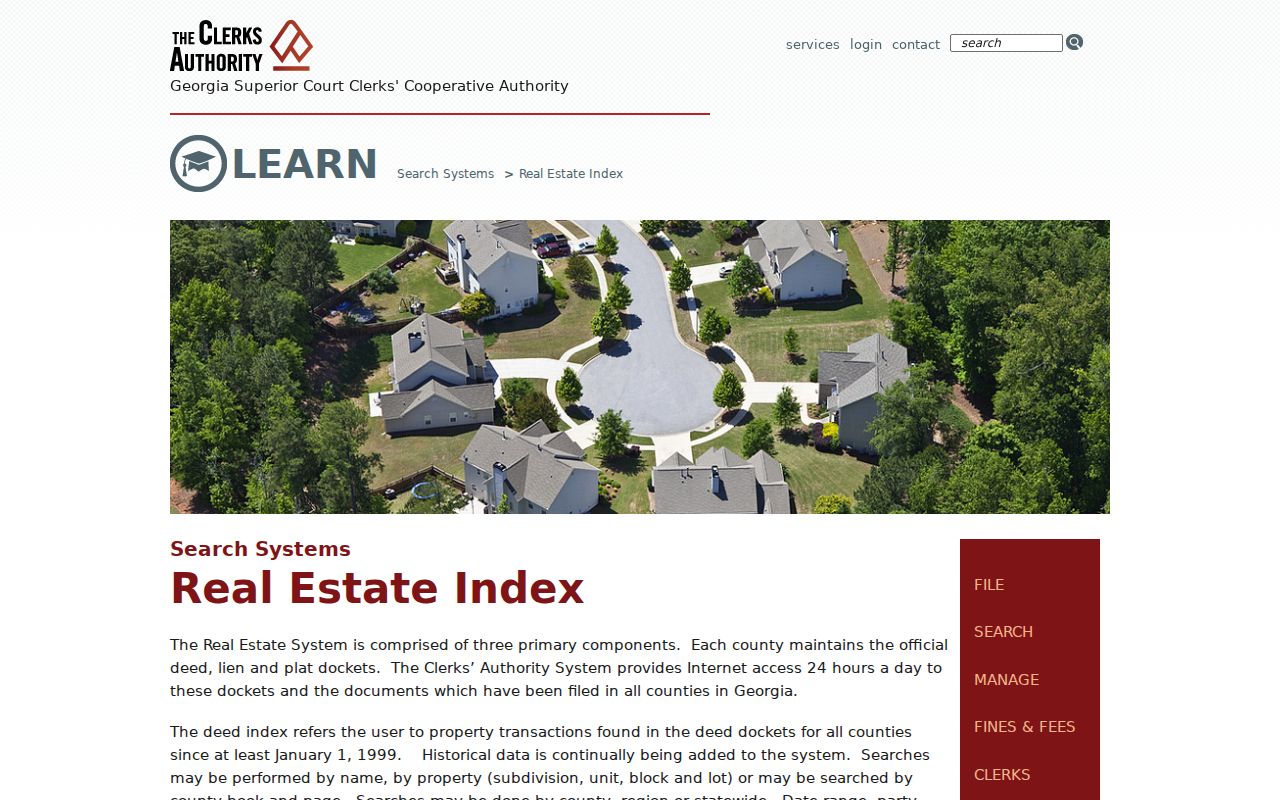
Select Decatur County and confirm the legal description before accepting a same-name hit.
Decatur Plats Anchor Old Deeds
City deeds often cite subdivision, lot, block, and plat book. Rural Decatur deeds lean on land lot, district, acreage, metes and bounds. They may also name waterways, roads, or adjoining owners. Search the historic plat index through 2004, then GSCCCA's plat index from 2004 forward.
A parcel split can mint a new tax ID while the parent-deed trail survives intact. Follow every cited plat and prior reference. QPublic gives you a modern parcel key. But the recorded deed and plat carry the land description that lasts.
Liens and Releases Beside Deeds
Beside the deeds, scan security deeds, assignments, cancellations, mechanic's liens, judgments, tax liens, FiFas, lis pendens, easements, covenants, and rights-of-way. GSCCCA indexes liens statewide from 2004. It also indexes UCC filings from 1995.
An index hit may carry a later release, satisfaction, cancellation, foreclosure, merger, or court order. A UCC filing can attach to equipment or fixtures rather than land. Read the collateral and property description before calling anything an encumbrance on the parcel.
Note: A recorded claim is not always an active claim. Always trace its later filing history.
FANS Watches Decatur Filings
The free Filing Activity Notification System lets you watch a name, property address, original deed book and page, or document criteria. New activity alerts arrive once you enroll. A notice can flag a deed, lien, or security instrument for prompt review. FANS rebuilds no historic deed records. It guarantees no notice. Open the filing itself, or request it from the Clerk. Treat the alert as a fraud-monitoring aid. It is never proof of title.
Decatur Deeds Before Street Numbers
Decatur County was organized in 1823, the same year its historic deed index begins. Old instruments describe land through districts, land lots, the Flint River system, ferries, mills, plantations, and roads. Neighbors anchored many of these deed descriptions too. A modern address search can miss a correctly indexed deed for that reason.
The Georgia Archives offers county-record and microfilm guidance. Bainbridge directories and Decatur newspapers help normalize old streets or occupants, though neither proves ownership. No courthouse fire or lost-book chronology appears in the official record. So never label a missing deed destroyed without Clerk confirmation.
Get a Decatur County Deed Copy
Begin with the index reference, then request the image from GSCCCA or the Clerk. A universal account unlocks GSCCCA eCertification. If an image is absent, try the courthouse terminal. The counter, telephone, mail, or a focused Georgia Open Records Act request also work.
Supply names, recording date, and deed type. Include the book and page or instrument number. Add the legal description too. Say whether you need a plain or certified copy. The official material publishes no exact Decatur copy fees. Confirm the current schedule before ordering.
Recorded, not guaranteed. Recording gives public notice, but it does not prove good title, remove every claim, or replace review by a qualified title professional.
Estate Transfers in Decatur Deeds
Death interrupts many Decatur County deed chains. The Probate Court keeps the estates, wills, guardianships, and conservatorships. The Superior Court Clerk handles the rest. Executors, administrators, trustees, and beneficiaries all show up in recorded instruments that touch real estate. Start from the deceased owner's deed. Then find the estate case. Then trace every later instrument that names the land.
Georgia death records help separate people who share a name. State law limits certified copies. A public plain-paper version may hide the Social Security number. Remember what a death record proves. It confirms the death itself, not any transfer of land. Only the probate authority plus a recorded conveyance close that gap.
Line up the fiduciary names, case references, signatures, dates, and legal description. Heirs sometimes appear with no deed at all. In that situation, title work may pull in the estate file, affidavits, year's support, orders, and corrective instruments filed later. A family source naming an heir is never enough to place that person in a deed chain.
Decatur Court Filings Affect Title
Decatur Superior Court decides title-to-land and equity disputes, including quiet title and partition actions. Civil filings tied to foreclosure, lis pendens, judgments, and orders can also explain why the deed index looks incomplete. Georgia Courts offers Decatur Superior and State Court electronic access through an account-based provider, and the Clerk's local courts page describes which court has jurisdiction.
A party-name match proves little by itself. Link the case number to something concrete: a parcel address, legal description, deed reference, lien, tax deed, or recorded notice. Then read the final order, any dismissal, the settlement, the sale result, and the deed that follows. A pending case never confirms a change of ownership.
Ask the Clerk directly when the provider blocks images. Federal bankruptcy and other federal litigation live in PACER, Middle District of Georgia. Save your source and date. Case status shifts after any search.
Recorded Deed Search Quality Checks
Five facts deserve a final comparison in any Decatur County deed-record search: exact party names, recording sequence, instrument type, prior reference, and legal description. Acreage alone is a weak anchor. One deed can convey several tracts, and one tax parcel may cover only part of an older tract. Street addresses falter too in older chains.
Watch for exceptions and reservations next. Mineral rights, timber rights, life estates, easements, rights-of-way, restrictive covenants, and partial interests can survive a transfer or travel separately. Read every attachment and referenced plat. An index label rarely holds all the operative language.
Search forward from each instrument afterward. Corrections, assignments, releases, and later conveyances all matter. Check your result against QPublic's parcel and owner display, though the certified roll remains the real assessment evidence. For a purchase, sale, estate, or boundary dispute, let a qualified Georgia attorney or title professional judge the full record chain.
Electronic records add one more check. GSCCCA's current filing information reflects an identity-verification requirement for electronic real-estate filings effective January 1, 2025, under O.C.G.A. §44-2-39(b)(1). Its system also flags statutory updates on transfer-on-death deeds. Follow the live filing rules instead of an old procedural summary. These changes affect submission and research, not the core task. The work stays the same: locate the indexed filing and read its full terms. Tie it to the same Decatur County land and hunt for later instruments. Confirm the legal effect of any new deed type or workflow with current Georgia law and the Clerk. Never infer it from an index label.
Keep the filing receipt, indexing date, and any correction notice. Electronic submission still demands a comparison. Match the final recorded image against the instrument tendered. The recording stamp, party index, and legal description must agree. Only then should the reference join a chain.