
Start a Decatur County Property Search
The practical first stop is the Decatur County QPublic search. One lookup there returns the situs address, owner display, parcel identifier, legal description, land and improvement values, exemptions, tax district, and any map or sales link the roll provides. Copy those identifiers before going further. A name alone can match several people. A mailing address may sit far from the land itself. Next, set the parcel data beside the latest deed indexed by the Clerk of Superior Court. The Tax Commissioner then supplies bill amounts, due dates, payments, delinquencies, and tax-sale facts. QPublic map context and recorded plats help locate the tract, but no tax card or map line substitutes for a title opinion or a boundary survey.
- Search QPublic by situs address, owner, or parcel number and save the exact parcel identifier.
- Use that owner and legal description in the Clerk and GSCCCA deed indexes.
- Open the Tax Commissioner account to check the bill and payment status.
- Compare the parcel map with recorded plats and deed descriptions.
- Ask the custodian for an image, certified copy, or record missing online.
Note: Record the source date beside every owner or value, since the certified roll and the deed index update on different schedules.
Decatur County Property Records Offices
Three custodians divide the core work in Decatur County. The Clerk of Superior Court records deeds, liens, plats, UCC material, and related instruments. The Board of Tax Assessors sets fair market and assessed value. It publishes the digest through QPublic. The Tax Commissioner bills and collects the tax. All three offices sit at the county complex in Bainbridge. Each keeps its own separate record system.
Decatur County Clerk of Superior Court
112 West Water Street
Bainbridge, GA 39817
229-248-3025
Decatur County Board of Tax Assessors
112 West Water Street
Bainbridge, GA 39817
229-248-3008
Decatur County Tax Commissioner
112 West Water Street
Bainbridge, GA 39817
229-248-3021
QPublic Connects Decatur Parcels
The assessor calls QPublic the county property-record search. A single parcel view can include the parcel number, location address, owner and mailing data, legal description, class, tax district, millage rate, acres, homestead status, land lot and district, and value history. The official QPublic landing page is the right entry point. Accept the disclaimer and search with the narrowest key available. Save the parcel number even when the address works. Parcel numbers survive spelling and street-format differences far better than names do. The assessor's official page also displays the route into the county property search. Open the Decatur County property-search source.
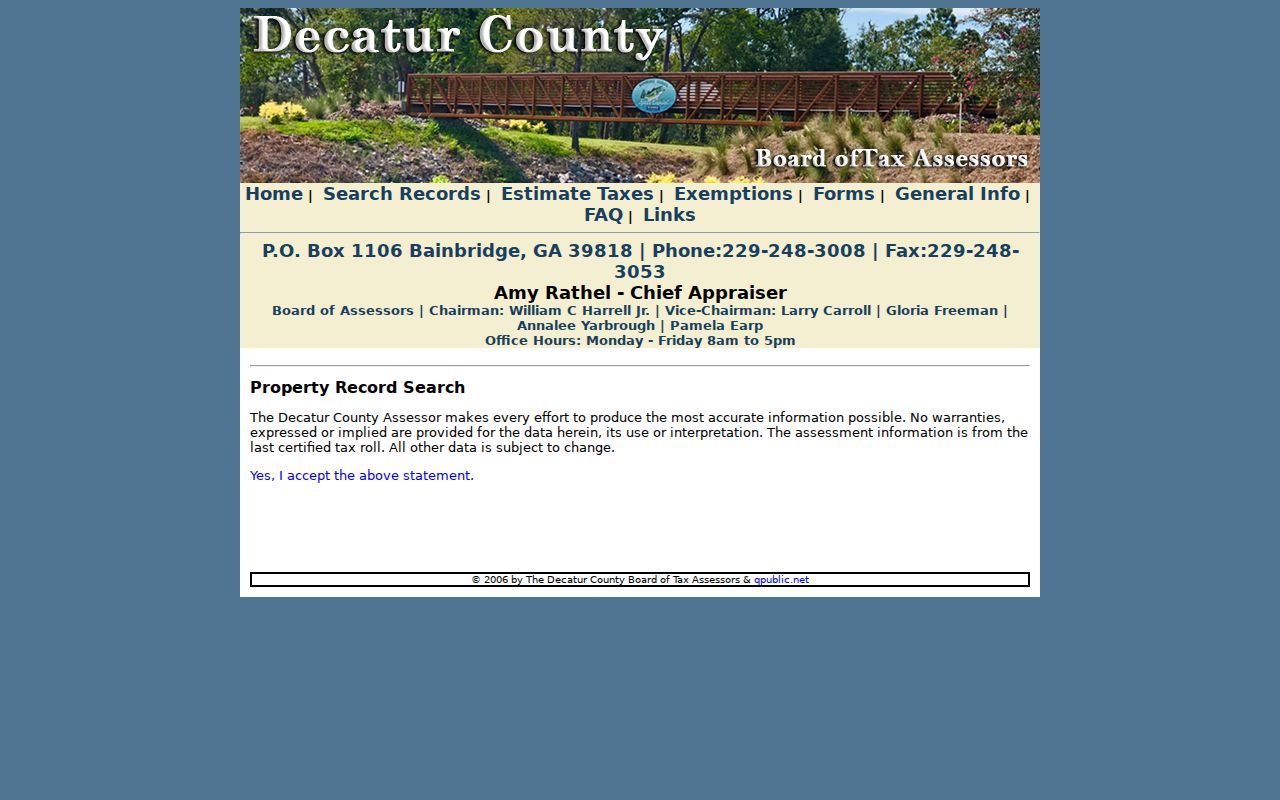
Note: The county disclaimer confirms that results are assessment data from the published roll, not a guarantee of title.
Historic Decatur Deed Indexes
Decatur County offers an unusually long remote index. The QuickLink historic search covers General Grantor and Grantee Index books from 1823 through 1994. It also includes the General Index to Plats from 1853 through 2004. Search fields in the historic portal include index book type, year, and party last name. Party first name rounds out the options. The index only points the way. What it yields is a deed book, a page, or another reference. It is not the instrument itself. QuickLink directs researchers to GSCCCA for related book images. For material not visible remotely, the Clerk counter remains the fallback.
| Historic set | Coverage | Best use |
|---|---|---|
| Grantor and grantee indexes | 1823–1994 | Trace sellers and buyers |
| Plat index | 1853–2004 | Find subdivision and survey references |
| GSCCCA deed index | Statewide from 1999 | Find current instruments and images |
Note: Check both routes for the overlap years, because local historic indexing and the statewide system may expose different clues.
Decatur County Property Record Types
No single Decatur County property record answers every question. The deed establishes the recorded transfer, while the tax card organizes assessment facts. The bill shows collection status. A plat depicts a surveyed division of the land. Court and permit records add context when a dispute or improvement affects the parcel.
| Record Type | What It Documents | Kept By | Access |
|---|---|---|---|
| Deeds | Recorded ownership transfers | Superior Court Clerk | QuickLink, GSCCCA, counter |
| Mortgages and liens | Security interests and releases | Superior Court Clerk | GSCCCA and local files |
| Assessment and tax | Values, exemptions, bills, payment | Assessor and Tax Commissioner | QPublic and tax portal |
| Plats and parcels | Lot, block, tract, and map context | Clerk and planning offices | Plat index and parcel result |
| Permits | Work, inspection, and development history | Bainbridge-Decatur Planning | Permit portal and records request |
Reach for Decatur County deed records when tracing the recorded ownership chain, property tax records for valuation and billing, and parcel maps for geographic reference. A court docket or permit file can explain a dispute or project. Tie anything found there back to the parcel and its recorded instruments.
Forty Percent and Decatur Appeals
Georgia law assesses property at 40 percent of fair market value. In Decatur County, the Board of Tax Assessors determines value. The Tax Commissioner applies the millage rates and collects the bill. That division matters when a figure looks wrong. Payment questions go to the Tax Commissioner. A value challenge goes to the assessor. According to the county assessor, a taxpayer has 45 days from the assessment notice date to appeal. Returns and many exemption filings use the January 1 through April 1 period. Keep the notice envelope with the appeal. Keep the parcel number, sales evidence, photos, and any acreage or improvement corrections with it too.
Appeal clock. The 45-day period runs from the notice date, not from the tax bill or the day a QPublic result is viewed.
Decatur Tax Bills and FiFas
Real-property taxes in Decatur County come due December 20. Mobile-home accounts are due April 1, according to the Decatur County Tax Commissioner. The assessor's value is only part of the picture. The actual account shows the amount billed, payment status, delinquency, and any collection action underway.
A FiFa is a tax execution. The Clerk records it once an account sits unpaid for more than 30 days. Before acting on a FiFa hit, check several things. Look for payment, cancellation, levy, a tax deed, redemption, or later court action. The office's official tax-sale page publishes no current sale list. Call the office rather than trust an old notice.
Note: A tax execution is a recorded collection step, not proof that a parcel remains available for sale.
Decatur Plats and Planning Files
Decatur County offers no standalone parcel-GIS hub or public layer list. The dependable path combines map context and plat indexes. Map context sits on a QPublic property result. Plat indexes sit at the Clerk or GSCCCA, and one more source is Bainbridge-Decatur Building and Planning. That office runs subdivision and plat review, zoning, permits, and inspections.
A plat is a recorded drawing of a subdivision, lot, or surveyed tract. Older rural deeds may lean on other calls instead. They cite land lot, district, acreage, road, river, or adjoining owners. Use map lines to identify the records. Then read the deed and plat together. When a physical boundary matters, hire a surveyor.
- Parcel
- A tax and mapping unit identified by the assessor.
- Plat
- A recorded drawing that may show lots, dimensions, and easements.
- Situs
- The physical location, which can differ from the tax mailing address.
- Grantor and grantee
- The transferring party and receiving party in a deed.
FANS Watches New Decatur Filings
The GSCCCA Filing Activity Notification System is known as FANS. It sends free alerts when a new filing matches criteria you set. Those criteria can be a name, address, original deed book and page, or document type. A newly indexed deed, lien, or security instrument can trigger a notice. The service expanded during the 2023–2024 reporting period. It remains a practical fraud-monitoring step for Decatur County owners.
FANS has limits. It does not search the whole historic chain, and no alert system is foolproof. Treat each notice as a prompt. Open the instrument through GSCCCA or request it from the Clerk. Guard your portal passwords, and ignore anyone demanding payment through an unverified message.
View the official FANS source shown below.
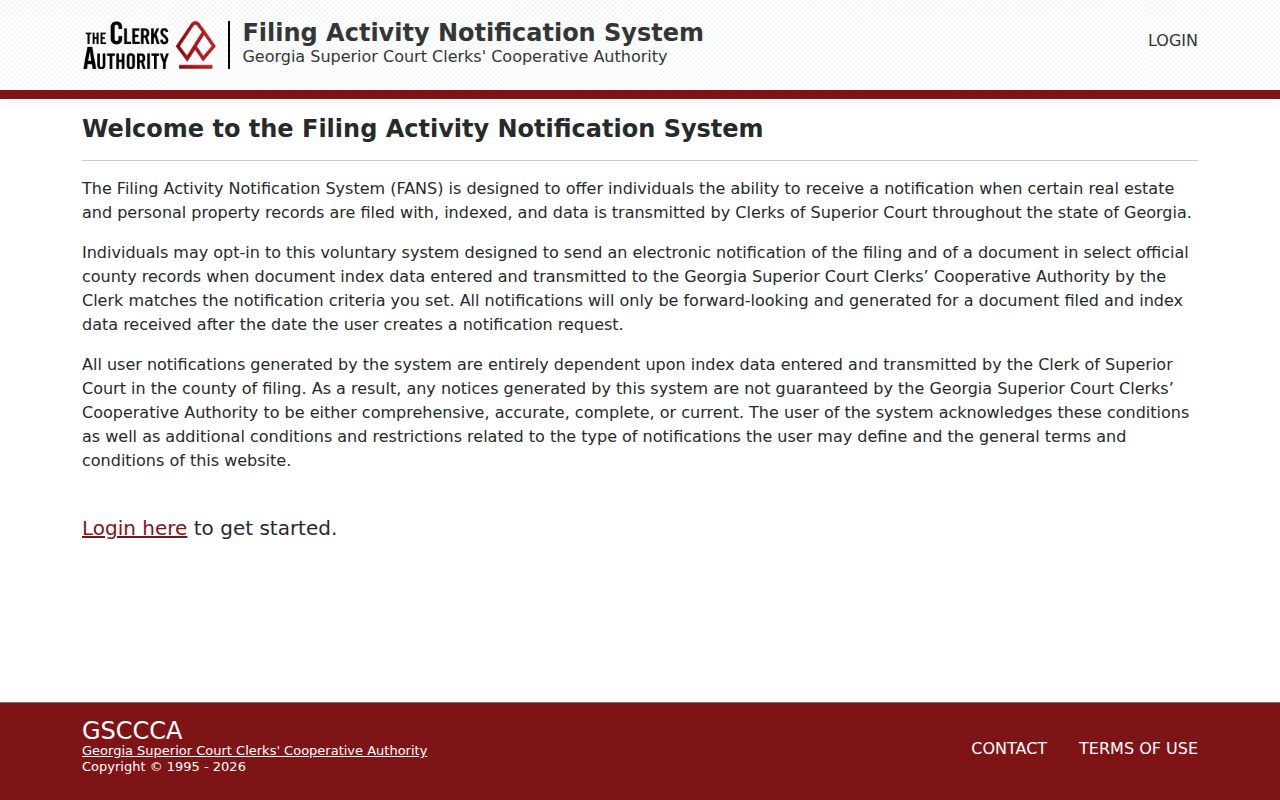
Note: The official screen is the registration and alert route, not evidence that a filing affects a specific parcel.
From 1823 Books to Digital Records
Decatur County was organized in 1823, and its historic grantor-grantee index begins that same year. That long run matters for farms, timber tracts, estates, and old Bainbridge lots. Those parcels were described long before modern street addresses. Deeds may cite land lots, districts, rivers, ferries, mills, plantations, and roads.
The record system has moved from courthouse books to QuickLink and statewide GSCCCA services. Statewide deed indexing runs from 1999, lien indexing from 2004, and plat indexing from 2004. No courthouse fire or lost-book chronology appears in the official record. Treat claims of destroyed Decatur County property records as unconfirmed unless the Clerk or Georgia Archives verifies them.
For deeper digging, the Georgia Archives research guide points to county records and microfilm. The Digital Library of Georgia carries Bainbridge directories. Historic newspapers cover Decatur news from 1866 through 1922. Those sources reveal occupants and local change. Deeds remain the proof of ownership.
Decatur Court Records Add Context
Superior Court handles title-to-land and equity matters such as quiet title and partition. The Clerk also keeps State Court records. The Georgia Courts e-access list names Decatur Superior and State Courts through an account-based provider. A party-name match alone proves nothing about the parcel.
Tie the docket to a legal description. Match the parcel address, deed book and page, lis pendens, lien, order, or final deed. A document may be unavailable online. Use the Clerk counter, a written request, or an eCertification route where it applies. Federal property litigation lands in PACER for the Middle District of Georgia.
See the official court-access source captured below.
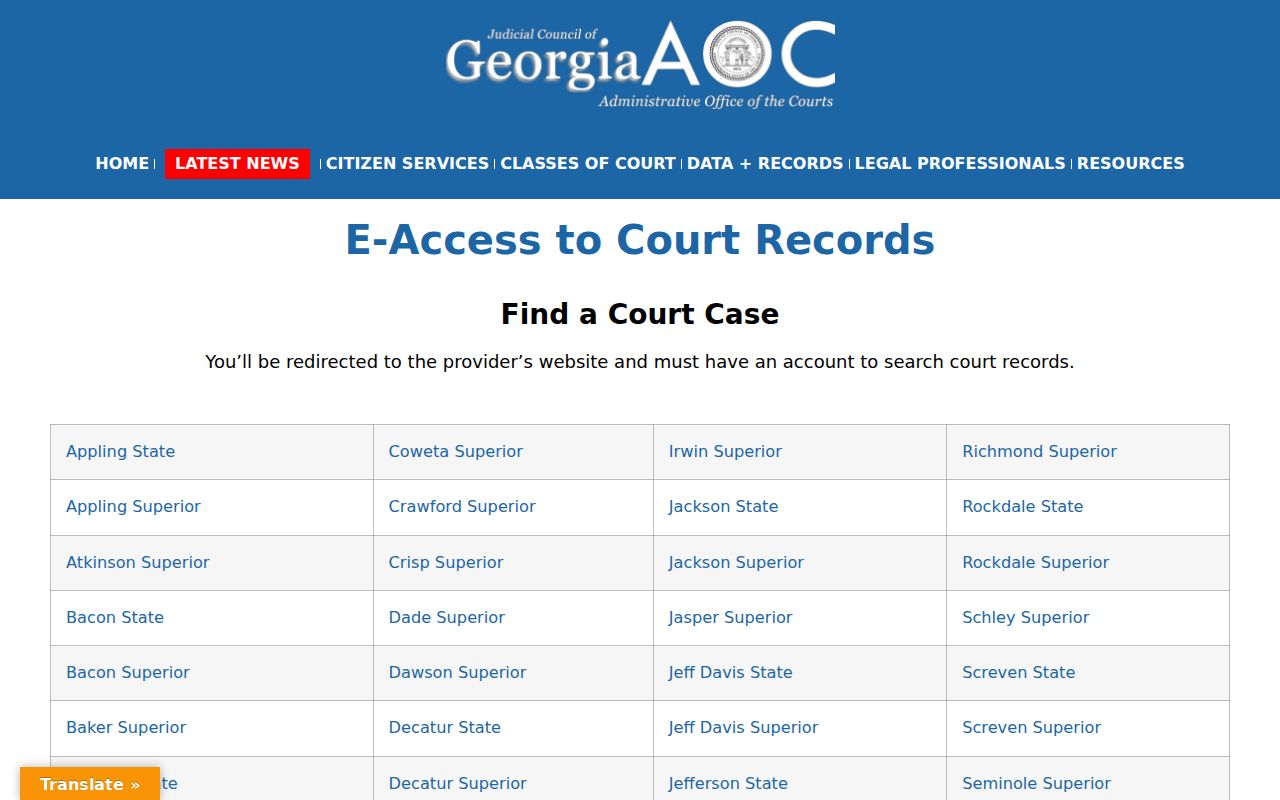
The provider list is an entry point; the docket still needs parcel-level verification.
Open Records Fills Online Gaps
The Georgia Open Records Act, O.C.G.A. §§50-18-70 through 50-18-77, opens a route to nonexempt records. Those are records that are not posted online. Agencies generally respond within three business days. Otherwise they provide a written timetable, an estimated cost, and any cited exemption. Search, retrieval, and redaction may be billed at the rate of the lowest-paid qualified employee. The first 15 minutes are free. Paper copies are generally capped at 25 cents a page under state guidance.
Describe the parcel, the date range, the record type, and your preferred electronic format. Ask the Clerk for an unposted deed image or an old index page. Ask planning for permit and plat-review files. Ask the tax offices for account material in their custody. A narrow request is faster to locate and easier to price.
Limits of Decatur County Property Records
Official Decatur County property records can show an owner name on the certified roll. They can show a grantee in the latest indexed deed, assessed values, exemptions, tax status, recorded liens, plat references, and court activity. They cannot guarantee clear title. They cannot set a boundary on the ground, prove who occupies a home, or fix a sale price. Trusts, estates, companies, protected addresses, spelling variants, and update lag all call for care.
Georgia Safe at Home and VoteSafe can substitute or protect eligible addresses. Ordinary land records stay public. A mailing address is never permission to contact or approach someone, though. Use the data for lawful research, purchase diligence, estate work, boundary questions, and civic review.
Lawful use. Decatur County property records support due diligence and civic transparency. They do not replace a title professional or surveyor, and owner data must never be used to harass or harm anyone.
Decatur Municipal Records Add Context
A mailing address can mislead. Even when an envelope says Bainbridge, Attapulgus, or Brinson, the land still answers to Decatur County offices. Those offices control the deeds, assessments, tax bills, and plats for that land. City records cover a smaller range of questions. Bainbridge and the county run a shared permit system. It handles applications, plan uploads, payments, inspections, and parcel information. It covers permits both issued and pending. The city's zoning StoryMap adds an address or PIN search. For older permit cards, ask the city or the county planning office directly.
Attapulgus and Brinson publish no public permit or zoning database. Their city clerks hold the ordinances, annexation files, and street records. They also hold any permit material kept locally. Work can predate current arrangements. Check with county planning about which office held authority at the time.
Postal geography deserves caution. ZIP labels rarely match incorporated boundaries on rural roads and city edges. Bainbridge's comprehensive plan points to Twin Lakes, West Bainbridge, the historic downtown grid, and growth corridors. But a planning-area label is not a recorded subdivision. The Clerk's plat index settles the question. It gives a formal name, lot, block, and book and page.
Municipal sources add color to a Decatur County property search. They never replace the official land records. A permit proves approved work. A zoning map shows a planning classification. An annexation exhibit records a boundary action. Only a recorded deed proves the conveyance itself.
Check any combined result before you trust it. Compare the parcel number, tax year, and recording date side by side. Check the legal description and supplying office too. The same Decatur County land can carry an abbreviated owner name in QPublic. A deed may show a full legal name, and the tax account a prior January 1 name. Treat that mismatch as a prompt to inspect dates. Never use it as grounds to merge people or files. For a rural tract, write down the land lot, district, acreage, road, and adjoining-owner calls. For a city lot, note the subdivision and its plat reference. Those details anchor a broad property-record search to one parcel.